Tuesday, 21 January 2014

Food and Greenhouse Gases: An Ominous Future?

Post written by C. Will

In a world increasing in population and wealth, food production needs to be steadily increasing to meet the growing demand. However, a recent study in Nature Communications (discussed here) argues the rate of yield gains in wheat and rice production have plateaued, despite increased investment in R&D and education. Other studies (for example Ray et al. (2013)) have also found evidence that the current yield gain in major crops is insufficient to reach the estimated 60% increase in production required by 2050. If wheat and rice production have approached a yield ceiling it provides an ominous future for food security.

Previous increases in yield gain have been driven by investment in technologies that were largely one-time innovations and cannot be repeated. For example, innovations in genetically modified grains, major investment in irrigation infrastructure and increased use of fertilisers and pesticides saw steady increases in grain production.

Is livestock agriculture also at risk of approaching a yield ceiling?
New Zealand has experienced significant annual increases in livestock productivity for more than 20 years.  As we discussed in a previous post even with existing technology there is room for significant ongoing improvement as less efficient farmers catch up with those who are more efficient. In the short term, constraints on yield per hectare (intensity) are likely to be environmental (water quantity and quality) rather than technological (as noted by the Parliamentary Commissioner for the Environment’s report on water quality). Internationally, the enormous differences in livestock productivity suggested by differences in emissions per unit of output suggest space for considerable yield gains.  

Globally we need to be making all the efficiency gains that we can to resolve the food security problem and New Zealand has an important role to play in this through the livestock sector.

Wednesday, 18 December 2013

An Economist’s Perspective on Value

Post written by C. Will

Motu has just released a Note on “Value and Natural Capital: Examining the Economist’s Perspective” written by Josh Pemberton and Suzi Kerr. The paper considers what economics brings to a conversation about environmental value, and what the limits of its contribution might be.

Many of you will have experienced how different people can view the same problem or issue in various ways. With this in mind, this paper seeks to highlight and examine the assumptions and implicit goals that underpin the way in which economists think about value in general, and environmental value in particular. 

FAO Report

Post written by C. Will

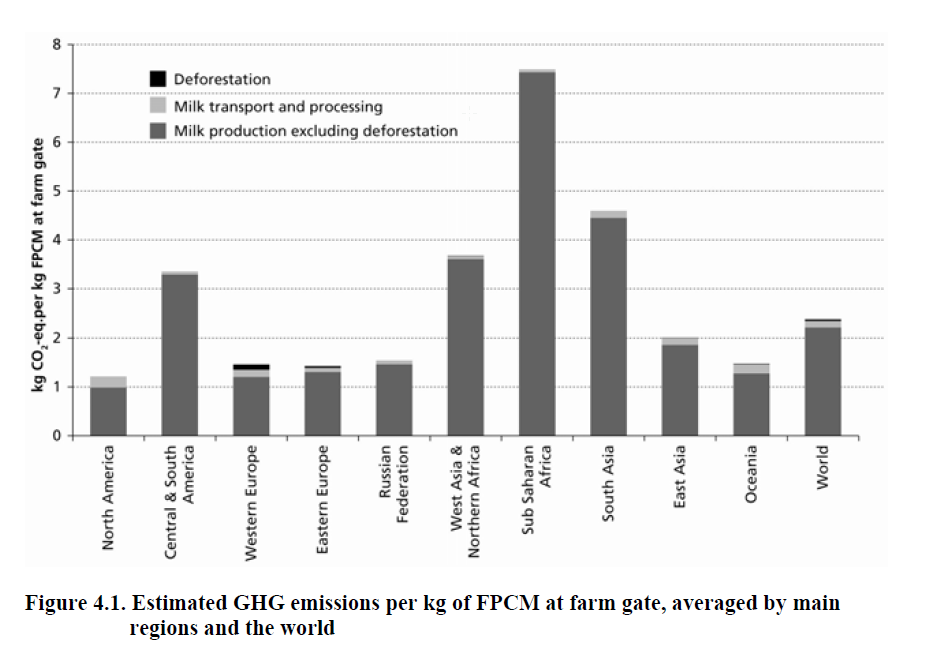
New Zealand (NZ) has relatively low emissions per unit of dairy production. So can NZ farmers share the skills and technologies that allow such low emissions to help lower global greenhouse gas (GHG) emissions?

The Food and Agricultural Organization (FAO) released a report in 2010 that looked into GHG emissions from the global dairy sector. Although the report is from 2010, it has some interesting findings worth discussing. In particular, a comparison of GHG emissions per kg of Fat and Protein Corrected Milk (FPCM) across different regions (see graph below).


Source: Gerber, P., Vellinga, T., Opio, C., Henderson, B., & Steinfeld, H. (2010). Greenhouse Gas Emissions from the Dairy Sector, A Life Cycle Assessment. FAO Food and Agriculture Organisation of the United Nations. Animal Production and Health Division, Rome. Page 34.


FPCM is a way of comparing milk produced from different dairy animals on a common basis by equating the level of fat and protein in the milk. The graph highlights where milk production is the most GHG emissions intensive and therefore the least efficient. There is a clear trend showing developing regions (Africa and Asia) having higher emissions than more industrialized regions (Europe and North America). 

We have been told that NZ emissions are even lower than the rest of Oceania; approximately 0.9 per kg of FPCM. This gives an idea how efficient NZ farming is and supports a comment in a previous blog that touched on the difference in efficiency between NZ farmers and farming in Africa. 


Monday, 16 December 2013

Thin Ice

Post Written by C. Will

Thin Ice is a New Zealand created movie that follows Simon Lamb (Victoria University of Wellington) as he travels around the world meeting the scientists behind climate change. The film is intended to help people develop a better understanding of climate change. The film also gives an introduction to the most recent Intergovernmental Panel on Climate Change (IPCC) Assessment Report.

Friday, 13 December 2013

Livestock: The answer, not the problem?


Post written by C. Will

Seth Itzkan of Planet-TECH discusses how holistic management can restore grass lands and reverse the effects of climate change in his TEDx talk; “How global warming can be mitigated through holistic management”.


In the video, Seth discusses his experiences in Zimbabwe and how the village herders have changed the way they manage their livestock. Using holistic management, they have replenished grasslands and during the dry season surface water is occurring further upstream than before. Increased availability of surface water has made farming easier and removed the need for water pumps, saving money. Regenerating grasslands also increases soil sequestration, reducing the amount of carbon in the atmosphere.

Holistic management uses livestock in a way that mimics wild herds which were a key component in the ecosystem when grasslands thrived. The wild herds would graze, naturally process the grass, fertilise the ground and then move onto a new area. The villagers are now replicating this process by running livestock in dense packs and moving them regularly just as a wild herd would. They also stick to grazing plans to prevent over grazing.         

Although his focus is on environments that have suffered desertification (the transformation of habitable land to desert), parallels can be made between the framework of holistic management and the way farmers in New Zealand manage their stock. Relative to farmers in Africa though, New Zealand farmers have lower emissions per unit of production and are more efficient. However, even in New Zealand many farmers can apply management strategies other farmers are already using to reduce their environmental impact. A recent Motu working paper, looks at such mitigation possibilities.

Holistic management was a way of managing resources originally developed by Allan Savory. Here Allan offers further discussion on holistic management and “how to fight desertification and reverse climate change”.


Saturday, 9 November 2013

A Negotiator’s Perspective: the Future of Agriculture in the UNFCCC Negotiations


Post written by H. Griffin.

With this year’s annual international climate change (UNFCCC) negotiations kicking off in Warsaw on Monday, now is a good time to look at agriculture’s place in the negotiations and where things might be headed in the future. 

Due in part to socio-economic and food security issues, progress in agricultural negotiations within the UNFCCC has been very slow. This is because of the role agriculture plays as a source of employment for many of the world’s poor, and the fact that many developing countries have had recent experiences of drought induced famine.

A new agreement is currently being negotiated and is expected to come into force in 2020 at the end of the Kyoto Protocol’s second commitment period. Whilst the Kyoto Protocol placed mitigation obligations on industrialised nations, the post-2020 agreement will be applicable to all nations. The negotiations are currently in a phase of design and preparation for the post-2020 agreement. It is particularly important that progress on mitigation and adaptation in the agricultural sector is made in preparation for the next agreement.

To give us a better idea about what is going on in the negotiations, Paul Melville from the Ministry for Primary Industries has kindly agreed to be interviewed for this blog. Paul is in Warsaw with the New Zealand government delegation as a negotiator in the area of agriculture.

Q. What is New Zealand hoping to achieve in relation to agriculture at the negotiations in Warsaw?

A. The discussions on Agriculture had a breakthrough at the inter-sessional meeting in Bonn this year. After many years of inconclusive negotiations, Parties agreed to a submission and workshop process as a first step of SBSTA (Subsidiary Body for Scientific and Technological Advice) work on Agriculture. This will be a useful opportunity for Parties to share experiences and lessons learned on agricultural adaptation and adaptation co-benefits. This workshop should facilitate more focussed negotiations on agriculture at Warsaw and future SBSTA sessions.

A successful work programme would aim to provide the UNFCCC with detailed scientific advice on issues relating to agriculture. One workshop will however unlikely deliver this. Though, it is often said that the hardest part of any process is taking the first step. The challenge for COP19/Warsaw is to ensure that Bonn was the first step in a wider process by continuing and building upon this work. If Warsaw was to fail to continue the progress made in Bonn we risk falling back into the previous pattern.

Q. What role can New Zealand play, both within and outside of the negotiations?

A. New Zealand likes to be a flexible thought leader wherever possible, piloting new ideas and working with a broad range of countries. We have expertise and a particular interest in issues related to agriculture, forestry and carbon markets.

Q. How is domestic policy in New Zealand relating to agricultural GHG emissions influenced by the international context?

A. There is a two-way relationship between domestic and international policy: domestic policy in New Zealand influences New Zealand’s international position; and international policy has an influence on New Zealand’s domestic policy.

While there is an influence in both directions, the two remain different. We promote international rules and commitments that are suitable for New Zealand’s domestic circumstances; and once agreed we implement commitments and rules using policies and measures that best suit our domestic policy environment.

Q. In your opinion, what would be the best outcome for agriculture in the post-2020 agreement?

A. The agricultural sector faces unique challenges. Agriculture is responsible for approximately 10–12 percent of global greenhouse gas emissions and is also an extremely vulnerable sector to the impacts of climate change. In addition to the challenge of having to simultaneously manage greenhouse gas emissions while adapting to climate change, it is forecast by the FAO that global agriculture will be required to increase production by 70 percent by 2050 to meet rising demand.

Outlining a best outcome for agriculture is difficult at this early stage of the negotiations as we are still working collectively in the UNFCCC on the design of the post-2020 agreement. However, by focusing on what we do know we can begin to understand what a good outcome for agriculture could look like.

We know the post-2020 agreement will include measures that will be ‘applicable to all’ Parties. We assume it will include, amongst other things, mitigation, adaptation and finance. We know that agricultural systems, including considerations of capacity, scale, culture, environment, efficiency and productivity are extremely varied, and it will probably not be possible to design a one size fits all rule set.

Therefore, in order to remain applicable to all, a key feature of any treatment of agriculture will be a need to adopt an approach with sufficient flexibility to cater for this broad range of national circumstances. In this sense, although agriculture has its own unique features, the broad principle of ensuring Parties are able to take commitments consistent with their specific national circumstances remains relevant here, too. New Zealand has outlined a concept of ‘Bounded Flexibility’ in a number of fora including the below submission which builds on this idea of a flexible framework.

http://unfccc.int/files/documentation/submissions_from_parties/adp/application/pdf/adp_new_zealand_workstream_1_20131015.pdf

Beyond outlining that any treatment will need to be sufficiently flexible to cater for national circumstances, it is very hard to predict or prescribe outcomes for a post-2020 agreement at this early stage.


About Paul:
I am a Senior Policy Analyst in the Ministry for Primary Industries International Policy Team. Our team covers environmental policy related to forestry or agriculture. In addition to agriculture in the UNFCCC, I also have responsibilities related to common metrics in the UNFCCC (global warming potentials), environmental footprinting policy and carbon footprinting policy. Prior to working for MPI I was a member of Fonterra’s Sustainability team. While at university and high school I paid my bills by milking cows and operating a successful calf rearing business on my parent’s dairy farm near Te Awamutu.

Wednesday, 6 November 2013

New Motu Working Paper Shows Significant Potential for Better Farm Management Practices to Improve Environmental Outcomes


Post written by H. Griffin.

This new working paper looks at differences in management practices of New Zealand dairy farms and the mitigation of nitrogen leaching and greenhouse gas emissions. Research on this topic in New Zealand to date has relied on simulation modelling and has been limited by the fact that different farms have generally been treated as homogenous. In reality, farms vary greatly – looking at this heterogeneity gives a better idea of the potential for better environmental outcomes through more efficient farm management practices.

Using data on 264 New Zealand dairy farms, the paper estimates the extent to which farm management and farmer skill could potentially reduce farms’ greenhouse gas emissions and nitrogen leaching per unit of production. It suggests that significant feasible, relatively low-cost mitigation could be effected by less efficient farmers moving towards existing best practice, potentially reducing nitrogen leaching by more than 30 percent and greenhouse gas emissions by more than 15 percent. The potential for such mitigation varies considerably across farms.

Check out the new paper here.